
If you’ve been researching AI search, you’ve probably come across terms like SEO, GEO, and AEO. They’re often discussed together, and while they overlap, they each focus on a different part of search visibility.
Search Engine Optimization (SEO) focuses on helping your website rank in traditional search results so users can find and click on your content. Generative Engine Optimization (GEO) focuses on increasing the likelihood that AI systems such as ChatGPT, Google’s AI experiences, Gemini, and Perplexity use or reference your content when generating responses. Answer Engine Optimization (AEO) focuses on making your content easy to understand and extract so search engines and AI systems can surface clear answers to specific questions.
The easiest way to understand the difference is to think about where the visibility happens. With SEO, you’re working to earn visibility in search results and ultimately drive someone to your website. With GEO, you’re working to establish your content as a credible source that can contribute to an AI-generated response. With AEO, you’re structuring that information so a specific answer can be easily identified and surfaced.
These strategies aren’t replacements for one another. In practice, they build on many of the same fundamentals and often work together. To see how, let’s imagine you own a personal injury law firm in Chicago.
Traditional SEO: Winning the Click
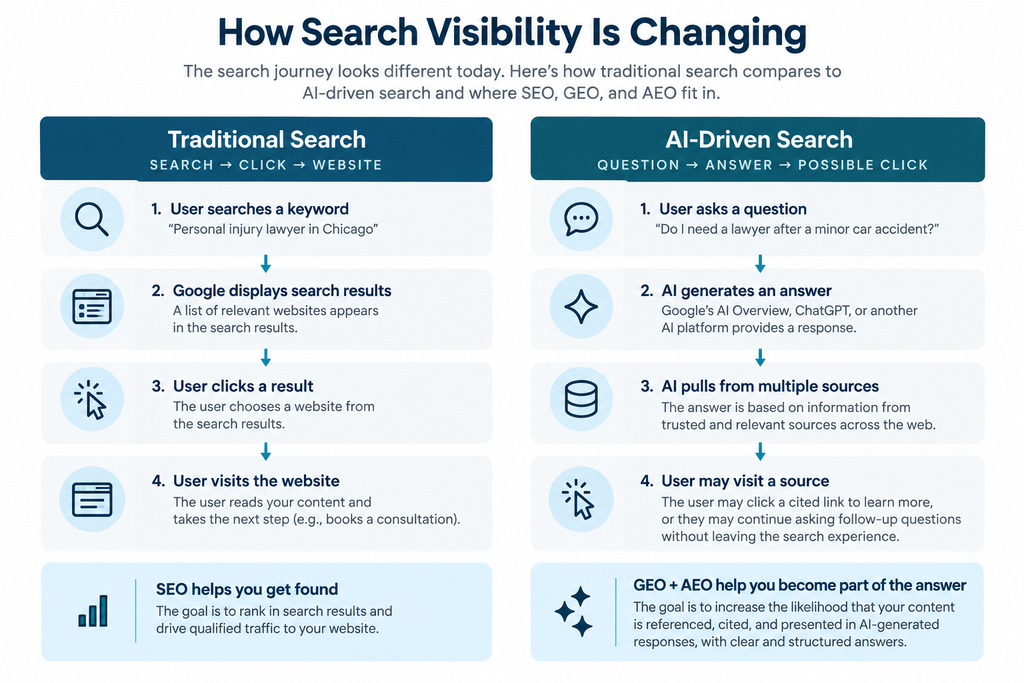
For years, the search journey was relatively straightforward. Someone had a question or needed a service, searched for it in Google, and chose from the websites that appeared in the results. Businesses invested in SEO because stronger rankings could lead to more qualified website traffic, which could ultimately lead to more customers or clients.
Imagine someone has just been involved in a car accident. They’re unsure what to do next and decide they may need legal representation, so they open Google and search “personal injury lawyer in Chicago.” Your law firm appears prominently in the results. They click on your website, learn about your experience, read about your personal injury services, and eventually schedule a consultation.
This is the traditional role of SEO. You’re helping search engines understand what your website offers, which searches your pages are relevant to, and why your content deserves visibility. The goal is ultimately to connect the right searcher with the right page.
That involves several pieces working together, including:
- Technical SEO that allows search engines to properly crawl and index your website
- Content aligned with the topics and searches your audience cares about
- Backlinks and other authority signals
- Local SEO and Google Business Profile optimization
- Website performance and user experience
When these elements are working together, your website has a stronger foundation for appearing when someone searches for the services, products, or information you provide.
The important part of this traditional journey is what happens after the search: the user typically needs to click a result to continue getting information. AI-driven search is beginning to change that step.
How AI Is Changing the Search Journey
Let’s go back to the same person who was just involved in a car accident. This time, they aren’t ready to search for an attorney. They first want to understand whether they even need one.
Instead of searching “personal injury lawyer in Chicago,” they might ask Google or an AI platform a much more conversational question, such as “Do I need a lawyer after a minor car accident?”
The experience that follows can look very different from traditional search. Google may provide an AI-generated response directly within the search results. Someone asking ChatGPT, Gemini, or Perplexity may receive a detailed answer and continue asking follow-up questions without immediately visiting another website.
That doesn’t eliminate the role of websites or the content businesses publish. It changes how that information can reach the user. A website can now gain visibility not only by appearing as a search result, but also by providing information that AI systems can understand, reference, cite, or use when generating an answer.
This is where the distinction between traditional SEO and newer approaches like GEO and AEO becomes important
What Is Generative Engine Optimization (GEO)?
Generative Engine Optimization, or GEO, focuses on increasing the likelihood that your content is recognized as a useful and credible source within generative AI experiences.
Continuing with our law firm example, imagine your firm has published an article titled “What to Do After a Car Accident in Illinois.” A basic version of that article might provide a generic checklist of what someone should do after an accident. A stronger resource could go much further by explaining Illinois-specific considerations, answering common questions clients bring to your attorneys, referencing authoritative legal sources, including insight from an experienced attorney, and keeping the information current.
That depth matters because generative AI systems need information they can interpret and use when constructing responses. GEO is focused on strengthening the signals that make your content useful in that environment.
In practice, that means creating content with:
- Clear subject-matter expertise
- Accurate and well-supported information
- Original insights, examples, research, or first-hand experience where appropriate
- References to credible sources
- Strong topical depth
- Clear information about who created or reviewed the content
- Current information that is maintained over time
The key difference is the desired outcome. With traditional SEO, you may be trying to get that car accident article to rank for a relevant Google search and earn a click. With GEO, you’re also considering whether the article provides enough authority and context to contribute to an AI-generated answer.
That doesn’t mean creating separate “AI content.” In many cases, the work that makes content stronger for GEO also makes it better for users and traditional search. The focus remains on creating something genuinely useful, but the potential places where that content can gain visibility have expanded.
Where AEO Fits In
This is where GEO and AEO can start to sound almost identical. Both involve making your content more useful in search experiences that provide answers directly to users. The difference is primarily in what you’re optimizing for.
GEO looks more broadly at whether your content has the credibility, depth, and authority to contribute to a generated response. Answer Engine Optimization (AEO) focuses more specifically on making individual answers clear and easy for a system to identify, understand, and surface.
For example, our law firm’s car accident guide might include a section answering the question:
How long do I have to file a personal injury claim in Illinois?
If the answer is buried inside several paragraphs covering multiple legal topics, the information may technically be there, but it’s harder to isolate. An AEO-focused approach would give that question its own descriptive heading, answer it clearly, and then provide the additional context someone needs to understand the answer.
This type of structure can include:
- Question-based headings that reflect how people actually search
- Direct answers followed by supporting context
- Clearly organized sections
- FAQ content where it genuinely serves the user
- Tables or lists when they make complex information easier to understand
- Appropriate structured data and technical markup
AEO isn’t about reducing every topic to a one-sentence answer. Some questions require context, nuance, or explanation. The goal is to make the primary answer clear before expanding on it, rather than forcing users or search systems to dig through an entire page to determine what the answer is.
That distinction is also what makes AEO useful beyond AI search. Featured snippets, voice search, and other direct-answer experiences have relied on many of these principles for years. Generative AI has simply made clear content structure even more important.
How SEO, GEO, and AEO Work Together
Once you look at all three in practice, the lines between them become much easier to understand.
Our law firm doesn’t need one article for SEO, another for GEO, and another for AEO. The same car accident guide can support all three when it’s built correctly.
From an SEO perspective, keyword research and search intent help determine what the page should cover and which searches it may be relevant to. Technical SEO, internal linking, backlinks, and the broader authority of the website can help the page compete in traditional search results.
From a GEO perspective, the depth of the article matters. Attorney insights, Illinois-specific information, authoritative references, original experience, and accurate information help establish the content as a stronger resource that generative systems may be able to use.
From an AEO perspective, the structure matters. Clear questions, direct answers, descriptive headings, and logically organized sections make individual pieces of information easier to interpret and surface.
The differences can be summarized simply:
| Strategy | Primary Focus | Law Firm Example |
| SEO | Ranking and organic visibility | The car accident guide appears in relevant Google search results. |
| GEO | Visibility within generative AI experiences | The guide provides authoritative information that can contribute to an AI-generated response. |
| AEO | Clear, extractable answers | A clearly structured section answers a specific car accident question directly. |
The strategies are different, but the underlying content doesn’t have to be. A well-researched, authoritative article that satisfies search intent and is organized around the questions users actually have can support visibility across all three.
What This Looks Like for Another Business
The same concept applies well beyond professional services like law firms. Consider a local dental practice that offers clear aligners.
Someone who already knows what they want may open Google and search “clear aligners near me.” Traditional SEO helps the practice’s clear aligner service page compete for that search and gives the potential patient an opportunity to visit the website, learn about the treatment, and schedule a new patient visit.
Another potential patient may be much earlier in the process. They know they want straighter teeth, but they aren’t sure which treatment makes sense. Instead of searching for a dentist, they ask an AI platform “Are clear aligners better than braces for adults?”
Now the opportunity looks different.
If the dental practice has published a comprehensive guide comparing clear aligners and traditional braces, that content could support visibility within an AI-driven search experience. The strength of that content from a GEO perspective might come from dentist-reviewed information, explanations based on real patient questions, credible references, and detailed information about who may or may not be a good candidate for each option.
Within that same article, the practice might answer specific questions such as:
- How long do clear aligners take?
- Can you eat while wearing clear aligners?
- Are clear aligners painful?
- How often do you need dental visits during treatment?
Those questions create opportunities for AEO because each answer can be clearly structured and easy to understand, while the overall article continues building the depth and authority that supports both GEO and traditional SEO.
This is why AI optimization shouldn’t be treated as a completely separate content strategy. The goal isn’t to create one set of content for Google and another for ChatGPT. It’s to create stronger content that can perform across multiple ways people now search.
Does AI Search Mean Traditional SEO Is Going Away?
No. Traditional search still plays an important role in how people discover businesses, research products and services, compare options, and make decisions. What is changing is that it’s no longer the only search experience businesses need to consider.
Some searches naturally lead to websites. Someone searching “personal injury lawyer Chicago” or “dentist near me” is showing strong intent to find a provider, and traditional search results remain an important part of that journey.
Other searches are increasingly being answered within the search experience itself. Someone asking a detailed informational question may receive an AI-generated response before they ever decide whether they need to visit a website.
That creates a broader definition of search visibility. Rankings and organic traffic still matter, but so does understanding whether your business and expertise are represented when AI systems answer the questions your customers are asking.
What This Means for Your Content Strategy
The rise of GEO and AEO doesn’t mean businesses need to abandon everything they’ve learned about SEO and start over. In many ways, it raises the standard for what good content should look like.
Keyword research still matters because you need to understand how people search. Search intent still matters because your content needs to satisfy what someone is actually trying to accomplish. Technical SEO, internal linking, website authority, and user experience still provide the foundation that allows your content to be discovered and understood.
What changes is what you build on top of that foundation.
Instead of publishing another generic article simply because a keyword has search volume, businesses need to think about what they can contribute that is genuinely useful. That may mean incorporating subject-matter experts, answering questions based on actual customer conversations, adding original data or examples, citing authoritative sources, providing more complete explanations, and updating important resources as information changes.
At the same time, that expertise needs to be presented clearly. A 3,000-word article can contain excellent information, but if the answer to a common question is buried somewhere in paragraph 17, both users and search systems have to work harder to find it.
This is where SEO, GEO, and AEO ultimately come together. SEO provides the foundation for discoverability. GEO strengthens the authority and usefulness of the information you publish. AEO helps organize that information so individual answers are easy to understand and surface.
Building for the Future of Search
Search has always evolved. The introduction of AI-generated answers is another major change in how people discover and consume information, but it doesn’t erase the fundamentals that made strong SEO effective in the first place.
Businesses still need technically sound websites. They still need to understand what their audiences are searching for. They still need authoritative content that demonstrates genuine expertise. And they still need to make that information easy to navigate and understand.
The difference is that the destination is no longer always a traditional search result.
Your content may rank in Google, contribute to an AI-generated response, provide a direct answer to a specific question, or support several of those experiences at the same time. Building content with SEO, GEO, and AEO in mind gives your business more opportunities to remain visible as those search behaviors continue to change.
The goal isn’t simply to rank anymore. It’s to become a source people and search systems can trust, regardless of how the search begins.
Strengthen Your Visibility Across Search and AI
As search continues to change, your strategy needs to account for both traditional rankings and AI-driven visibility. We help businesses build SEO and AI search strategies focused on stronger content, authority, and long-term visibility. Contact us to discuss how your business can strengthen its presence across traditional and AI search.